

AMD Server Solution India
High Performance EPYC Servers
Vays Infotech delivers industry-leading AMD server solution India for enterprises looking to build high-performance, scalable, and AI-ready infrastructure. Powered by the latest AMD EPYC server processors, our solutions are designed for modern workloads including cloud computing, AI, virtualization, and data analytics.
Whether you are upgrading your infrastructure or deploying new systems, our AMD-based servers provide unmatched performance using advanced AMD CPUs, AMD processors, and AMD GPUs.
Why Choose AMD Server Processors
AMD has transformed enterprise computing with its powerful EPYC server processors, delivering superior performance and efficiency compared to traditional server CPUs.
High core count AMD CPUs for demanding workloads
Optimized for AI, cloud, and virtualization
Cost-effective compared to traditional server processors
Advanced AMD core processor architecture
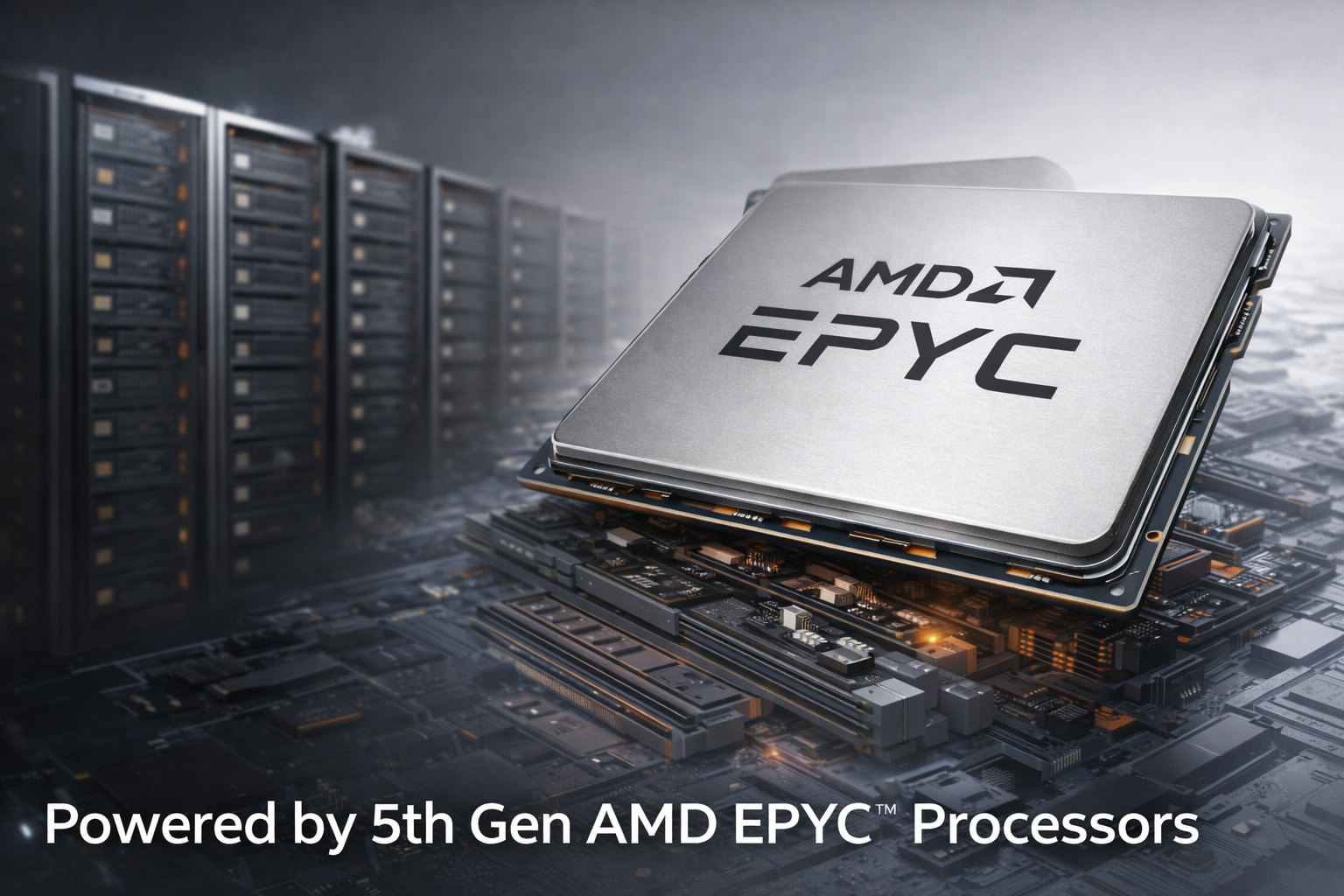
Why Choose AMD EPYC Servers?
AMD EPYC–based server platforms deliver high performance by offering high core density with advanced system architecture. It has Zen 4/5 (for maximum performance per core) and 4c/5c cores (for high-density, cloud-native workloads), offering more cores per die in a smaller physical footprint.
The architecture features Modular Chiplets instead of one large monolithic chip. EPYC uses a central I/O Die (IOD) surrounded by multiple Core Complex Dies (CCDs). Also, the Infinity Architecture of EPYC, the interconnect technology connecting CCDs to the IOD, provides high-bandwidth /low-latency communication between the sockets.
The large number of cores per processor makes them a great choice for virtualization and HPC workloads. With support for PCIe Gen4 and Gen5, these systems provide high-speed interconnectivity for GPUs, storage, and networking for the best data throughput.
AMD has designed its latest high-performance hardware (specifically GPUs like the Instinct MI300X and 5th Gen EPYC CPUs) to overcome the “memory wall”—the bottleneck where processors are faster than the speed at which the data is received, and a massive 128 PCIe Gen 5.0 lanes per socket help in handling data-intensive Workloads such as AI, analytics, and large-scale simulations.
– High Core Density – highly suitable for virtualization & HPC
– Superior Price-Performance – More compute per rupee
– Energy Efficient – Reduced TCO
– PCIe Gen4/Gen5 Support – Fast I/O for GPU, storage and networking
– Memory Bandwidth Leadership – Ideal for data-intensive workloads
AMD EPYC Server Processors – Built for Performance
AMD EPYC processors are designed for modern data centers and enterprise applications.
Advanced multi-core AMD server chip architecture
Enterprise-grade security and reliability
High-speed memory and storage support
Built for AI processor workloads and analytics
How AVX-512 Accelerates
AI, HPC & Data-Intensive Workloads
A single instruction that operates on 512-bit datasets simultaneously — unlocking massive parallelism for AI inference, financial modelling, and scientific computing.
512-Bit Wide
Data Processing
AVX-512 allows a single CPU instruction to operate on 512 bits of data simultaneously — processing 16 single-precision floats or 8 double-precision floats in one clock cycle. AMD Zen 5 doubles execution throughput by widening internal data paths and adding a second 512-bit FMA (Fused Multiply-Add) unit.
Increased Execution Parallelism
Zen 5 features widened data paths and an improved out-of-order execution engine, allowing multiple AVX-512 operations to be dispatched and completed in parallel — delivering higher throughput for neural network matrix multiplications, FFT computations, and Monte Carlo simulations.
AI & Machine Learning
Accelerates INT8 and FP16 inference for deep learning models. Larger batch sizes per instruction reduce memory round-trips, cutting latency in LLM serving and computer vision pipelines.
HPC & Scientific
CFD solvers, finite element analysis, and molecular dynamics simulations benefit from widened SIMD registers. Dense linear algebra routines (BLAS/LAPACK) achieve near-peak FLOPs per core.
Power-Efficiency Mode
When maximum throughput is not needed, AVX-512 workloads can be throttled via cTDP to reduce power draw — enabling flexible thermal budgeting across mixed-workload data centre deployments.
How Zen 5 Improves Data Center
& AI Performance
Higher IPC & Wider Pipelines
Zen 5 increases Instructions Per Clock by widening the decode, dispatch, and execution pipelines — more work completes in each cycle without raising frequency.
Dual 512-bit FP Execution
Two full-width AVX-512 FMA units deliver double the floating-point throughput compared to Zen 4, accelerating AI matrix math and HPC kernels at every frequency point.
Modular Chiplet Design
A central I/O Die (IOD) surrounded by Core Complex Dies (CCDs) connected via AMD Infinity Fabric — offering high-bandwidth, low-latency inter-die communication at scale.
Tiered Cache Architecture
Dedicated L2 per core plus large shared L3 per die ensures frequently accessed working sets stay close to execution units, minimising DRAM latency stalls.
High-Performance Core
High-Density Efficient Core
AMD 3D V-cache
AMD 3D V-cache is a major architectural enhancement and upgrade over its previous generation, 2D MCM design, which was launched as part of the 2nd Gen EPYC Processor in 2019 and further improvised in 2021. MCM is Multi-Chip Architecture, wherein multiple CPU (CCDs) and IO related Processor (IOD) nodes where in the same package.
The 3rd Gen AMD EPYC has arrived with 3D V-cache (code named Milan-x), where the chiplets are stacked in a 3D die by special copper to copper bonding and ‘through silicon vias’ (TSVs), giving the processor a multifold improvement of interconnect capacity compared to 2D MCM, offering high density, close proximity of chiplets and increased capacity. It offers lower latency, increased bandwidth and of course better thermal performance.
As a result, the L3 Cache capacity is tripled from 256 MB to 768MB per socket. HPC workloads like computational fluid dynamics (CFD), finite element analysis (FEA), electronic design automation (EDA) and RTL simulations related workloads deliver fast response.
AMD Server Use Cases
| Feature | AMD EPYC Processors | Traditional Server CPUs |
|---|---|---|
| Core Count | Higher core density for maximum performance & efficiency | Lower core count |
| Performance | Better performance-to-cost ratio | Higher cost, lower efficiency |
| AI & Cloud Ready | Built for AI, virtualization & cloud workloads | Limited AI capabilities |
| Energy Efficiency | Better performance per watt | Higher power consumption |
Deploy AMD-based servers for scalable cloud infrastructure.
Run multiple virtual machines efficiently using high-core AMD server CPUs.
Leverage AMD AI processors and GPUs for advanced workloads.
Process large datasets with high-performance server processors.
Use AMD's fastest processors for engineering and research applications.
- Higher core density than most core processors
- Better performance-to-cost ratio
- Optimized for AI and cloud workloads
- Latest AMD processors designed for future-ready infrastructure
AMD servers deliver better scalability, efficiency, and long-term value — making them the preferred choice for modern enterprise infrastructure.
