

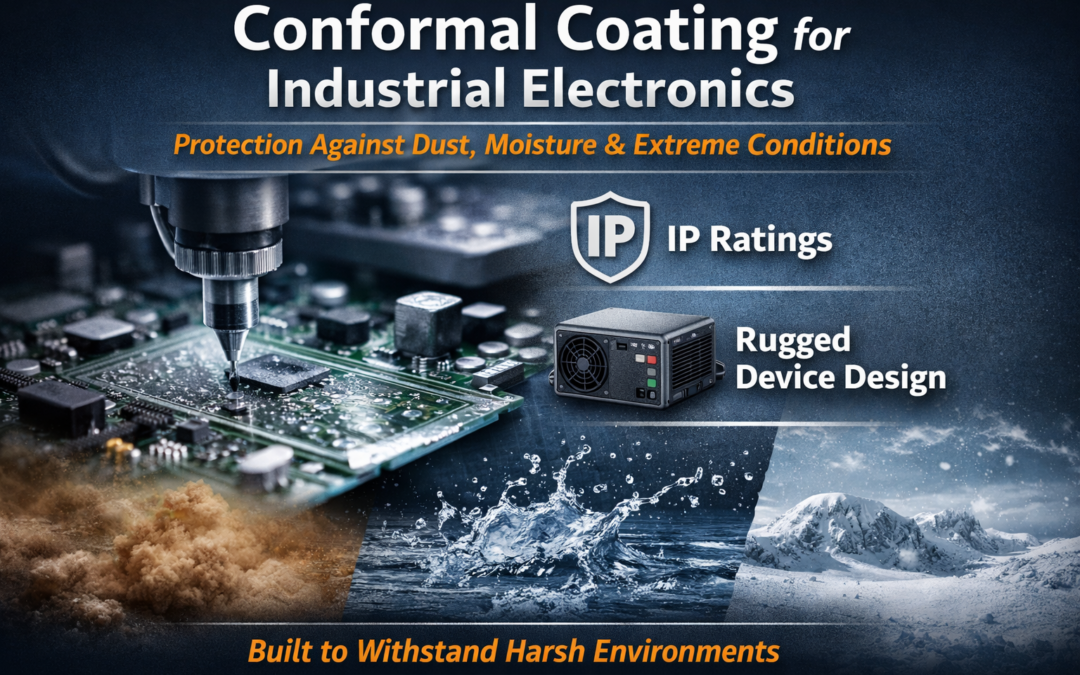
Rugged Devices
Industrial Environments demand Hardware that can withstand Extreme Temperature, Dust, Moisture and Vibration. Rugged devices/ Appliances for Networking, Security and shop floor HMIs or PCs are engineered for such environment to prevent costly downtime, worker safety and more importantly to withstand the harsh conditions peculiar to every industrial environment.
The following are the broader selection criteria of Rugged devices to be considered on the choice of Networking switches or Firewalls for the use of those on the premises. The technical specifications in terms of the features and the protocol support are the other aspects to be considered.
- Conformal Coating (Thermal and Dielectric properties)
- IP Ratings (Dust and Water proof)
- Construction of the appliances
- Certifications and compliances
Besides above, The Cabling, IO devices and screens of HMIs and PCs in the Shop floor or industries are of special designs. They are not covered in this discussion.
Thermal and Dielectric properties. What is Conformal Coating ?
Conformal coating is a protective thin-film layer applied to printed circuit boards (PCBs) to shield components from environmental stress. In the context of conformal coating for industrial electronics, this layer typically ranges from 25 to 75 microns in thickness and conforms closely to the contours of the board, providing insulation and protection without impacting functionality.
In industrial environments, devices are frequently exposed to moisture, dust, chemicals, temperature fluctuations, and corrosive gases. Conformal coating helps mitigate these risks by preventing corrosion, reducing leakage currents, and enhancing dielectric properties—making conformal coating for industrial electronics essential for ensuring long-term reliability and performance.
Common Conformal Coatings
Common types include acrylic, silicone, polyurethane, epoxy, and parylene, each suited for specific operational conditions such as high temperature, chemical exposure, or vibration.
Acrylic (AR) — Easy to rework, Low cost but poorly suited for heat above 125°C
Silicone (SR) — Very High temperature and vibration resistance
Polyurethane (UR) — strong chemical resistance, Extremely tough; resists fuels and oils better than acrylics.
Epoxy — high durability
Parylene – premium pricing, Ultra-thin vapor-deposited layer, Mil Spec, uniform coating
The use of conformal coating significantly improves the reliability, durability and performance of electronic assemblies, especially in mission-critical applications such as manufacturing automation, energy systems, transportation, and defense.
When combined with proper enclosure design (IP Protected) and thermal management, conformal coating becomes a key enabler for robust and resilient industrial systems, ensuring minimal downtime and consistent performance even in challenging environments.
Key standards and their aspects of conformal coating
Conformal coating in industrial electronics is governed by a range of international standards like IPC-CC-830, which defines qualification and performance requirements such as moisture resistance, dielectric strength, and environmental durability. Supporting this, IPC-A-610 and IPC-J-STD-001provide inspection criteria for coating coverage and quality, and process considerations during assembly.
In high-reliability sectors such as defense, MIL-I-46058C ( IPC-CC-830B is the current industry standard replacing the testing methodologies of 46058C ) referenced for its stringent requirements on insulation, corrosion resistance, and environmental protection. For safety and material compliance, UL 746E ensures coatings meet flammability and electrical safety standards, making it important for commercial and industrial deployments.
From an international perspective, IEC 61086 classifies coating materials and their performance, while IEC 60068 defines environmental testing such as thermal cycling, humidity exposure, and corrosion resistance—critical for industrial and IT-OT environments.
Across these standards, common evaluation parameters include insulation resistance, dielectric strength, adhesion, chemical resistance, and coating thickness. Together, they ensure that conformal coatings not only protect electronic assemblies but also enhance system reliability, reduce failures, and extend operational life.
While the conformal coating protects the PCB, the enclosure level protection is provided by Ingress Protection (IP Rating)
Dust and Water proof. What is INGRESS Protection (IP) Rating ?
Ingress Protection (IP) ratings, as defined in IEC 60529, indicate how well electrical enclosures are protected against solid objects (dust) and liquids (water). This represents enclosure-level protection, whereas conformal coating for industrial electronics provides protection at the PCB level, safeguarding internal components from environmental stress.
An IP rating is expressed as IPXY:
- X = Level of protection against solid particles (dust)
- Y = Level of protection against liquids (water)
| PROTECTION AGAINST SOLIDS (FIRST DIGIT) | PROTECTION AGAINST WATER (SECOND DIGIT) |
| IP1X – Protected against objects greater than 50mm (e.g., hand)
| IPX1 – Protected against vertically falling drops of water IPX2 – Protected against vertically falling drops with enclosure tilted up to 15° IPX3 – Protected against sprays of water up to 60° from vertical IPX4 – Protected against water splashes from all directions IPX5 – Protected against low-pressure water jets IPX6 – Protected against powerful water jets or heavy seas IPX7 – Protected against temporary immersion (15 cm to 1 m for 30 minutes) IPX8 – Protected against continuous immersion under pressure |
Example: IP65
IP65 means:
6 – Dust tight (complete protection against dust)
5 – Protected against water jets
Suitable for industrial environments, outdoor installations, and IT/OT deployments.
Construction of the appliances
A. Enclosure Design
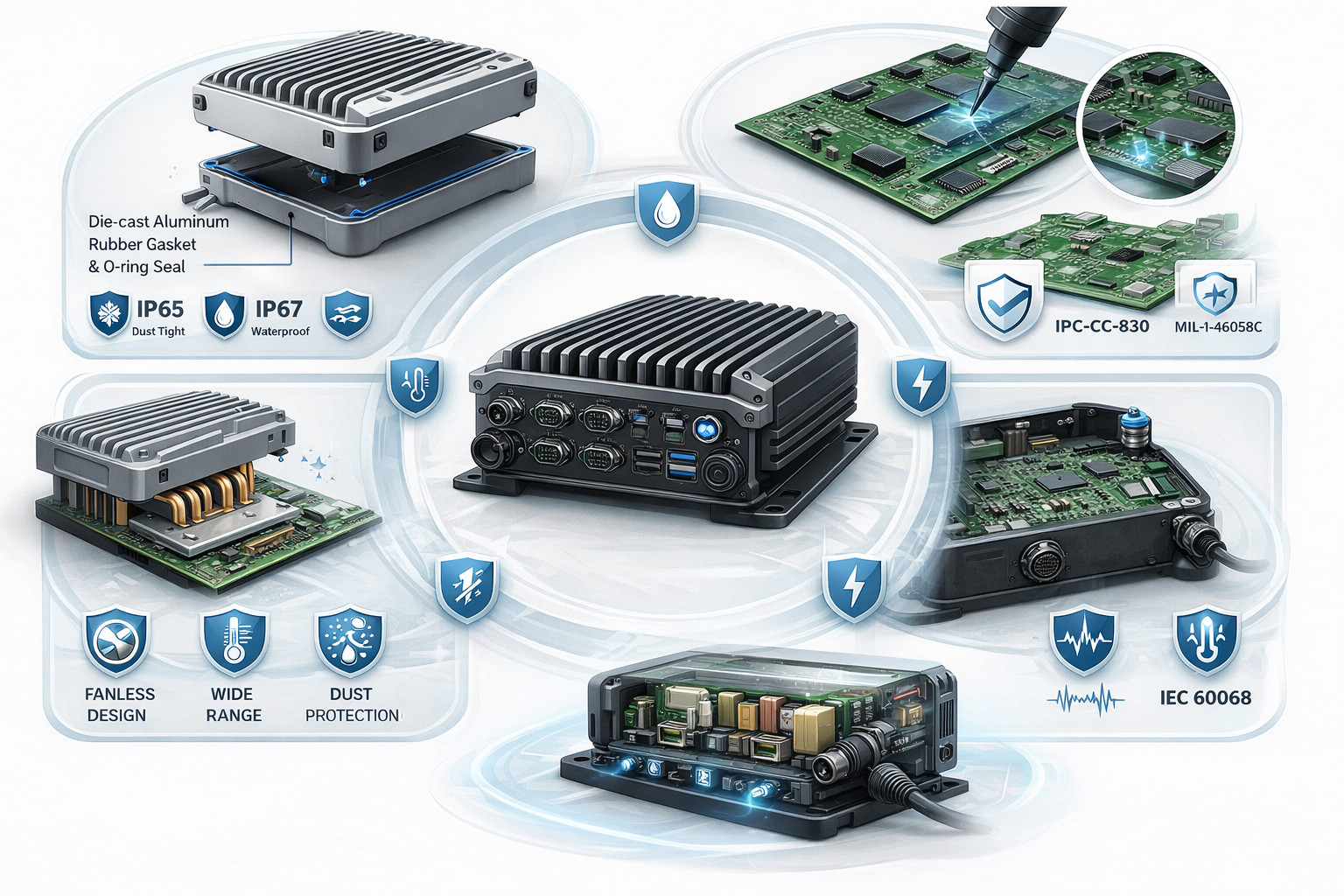
The enclosure is the first critical element of rugged devices. It is typically made from die-cast aluminum, stainless steel, or reinforced polycarbonate and is designed to meet IP ratings such as IP65, IP67, and IP68 for dust and water protection. These enclosures use rubber gaskets, O-rings, and sealed joints to prevent ingress, along with corrosion-resistant coatings for outdoor and chemically harsh environments.
B. Conformal Coating of PCBs
A key aspect of reliability is the use of conformal coating for industrial electronics, which protects printed circuit boards from moisture, dust, and chemical exposure. This process aligns with industry standards such as IPC-CC-830 and MIL-I-46058C, ensuring durability and consistent performance in harsh conditions.
C. Thermal Management (Heat Dissipation)
Rugged devices often operate in sealed environments, making efficient cooling essential. They typically use fanless designs with heat sinks, conduction cooling, thermal pads, and heat pipes. These systems support a wide operating temperature range while eliminating the risk of dust ingress caused by fans.
D. Shock and Vibration Resistance
To withstand mechanical stress, internal components are mounted with shock absorbers and dampers. Reinforced connectors and locking mechanisms further enhance durability. Compliance with standards such as MIL-STD-810 and IEC 60068 ensures reliability in demanding conditions.
E. Power Protection and Electrical Robustness
Rugged systems are built with wide voltage input ranges and include built-in surge protection, ESD protection, and EMI/EMC shielding. These features safeguard devices against power fluctuations commonly found in industrial environments.
Certifications and compliances
Key Certifications relevant to rugged network appliances in India
Here is a list of standards and key certifications relevant to rugged network appliances. This article also indicates the mandatory India compliance next to each of those. This is not an exhaustive list. The buyers are advised to do their research on compliances required for their specific industries/ environment before their purchases.
India Specific Mandatory for any relevant Hardware
BIS CRS (Compulsory Registration Scheme)
Bureau of Indian Standards (BIS) registration is mandatory for many electronic and most of the IT products sold in India. It Includes EMI/EMC requirements aligned to international IEC standards. Products must be tested in BIS-recognized labs and registered before sale.
TEC MTCTE
Mandatory for telecom and network equipment in India. It covers safety, EMC, and performance
WPC ETA Approval
Required for wireless devices (Wi-Fi, RF, Bluetooth). It Ensures spectrum compliance and interference control.
Environmental Protection & Ruggedness Standards
IEC 60529 (IP Rating)
Defines protection levels against dust and water ingress (e.g., IP65, IP67).
Ensures the device can operate reliably in environments exposed to dust, moisture, or water jets.
IEC 60068 (Environmental Testing)
Specifies tests for temperature, humidity, vibration, and shock.
Validates that equipment can withstand harsh environmental conditions over time.
MIL-STD-810
Military standard for durability under extreme conditions like shock, vibration, altitude, and temperature.
Widely used as a benchmark for ruggedness even in industrial and commercial devices.
NEMA Ratings (NEMA 250)
Defines enclosure protection against environmental hazards like dust, water, oil, and corrosion.
Commonly used in North America alongside IP ratings for industrial equipment.
Hazardous & Explosive Environment Certifications
ATEX (Directive 2014/34/EU)
Certification for equipment used in explosive atmospheres (e.g., oil & gas, chemical plants).
Ensures devices do not ignite flammable gases or dust.
IECEx
International certification for equipment used in hazardous explosive environments.
Provides global acceptance similar to ATEX but with wider international recognition.
PESO Certification (Petroleum and Explosives Safety Organization)
This is required in India for the equipments used in explosive or hazardous environments
Common in oil & gas, chemical, and refinery sectors. This aligns with and is required besides ATEX or IECEx
Electrical Safety & Product Compliance
UL Certification (UL 61010 / UL 62368-1)
Safety certification ensuring electrical and fire safety compliance.
Important for market acceptance, especially in North America.
CE Marking
Indicates compliance with European safety, health, and environmental requirements.
Mandatory for selling equipment within the European Economic Area.
Electromagnetic Compatibility (EMC/EMI)
FCC Certification (Part 15)
Regulates electromagnetic emissions to prevent interference with other devices.
Required for electronic equipment sold in the United States.
EMC / EMI Compliance (IEC 61000 Series)
Ensures devices do not emit or are not affected by electromagnetic interference.
Critical for stable operation in electrically noisy industrial environments.
Industrial Cybersecurity Standards
IEC 62443
Cybersecurity standard for industrial automation and control systems.
Ensures secure design and deployment of network devices in IT/OT environments.
Environmental & Regulatory Compliance (Sustainability)
RoHS (Restriction of Hazardous Substances)
Limits the use of hazardous materials like lead, mercury, and cadmium.
Ensures environmental safety and compliance in manufacturing.
Waste Management Rules (India) Governs disposal and recycling of electronic equipment, mandatory for manufacturers and importers RoHS is adopted in Inda via E-Waste Rules. It restricts hazardous substances like lead, mercury, required in enterprise procurement
Notes or Tips for the buyers.
Fanless design, IP rating of the enclosure and the Thermal Range are listed as a specification of the Network appliances usually in the first page itself, along with the functional or Technical features of the product. The Compliance of Standards or conformal coating are to be explored in their websites, generally not available as part of the brochures. Or talk to your system Integrator or reseller for specific requirements.
The power Quality of your factory or industry location has to be considered on the range of power supported as input of the devices. They are usually universal power supplies with wide frequency/ Voltage ranges. If you are considering to house the appliance in a standard PLC (DIN Rails) or Custom racks, give due consideration for the physical dimensions, fixtures and power.
