

The purchase price of an industrial firewall is the part of its cost that is easiest to see and least likely to surprise you. The expensive surprises live elsewhere: in the recurring security subscriptions, in the support tier, in the firmware policy that quietly removes a feature, and — on the other side of the ledger — in the failures and cooling costs a rugged design avoids. This article lays out the real total cost of ownership of a rugged network edge so the number you take to a budget meeting is the number you will actually live with.
Where rugged hardware saves money
Rugged appliances cost more than their office equivalents up front, and they earn it back in places that do not appear on the purchase order.
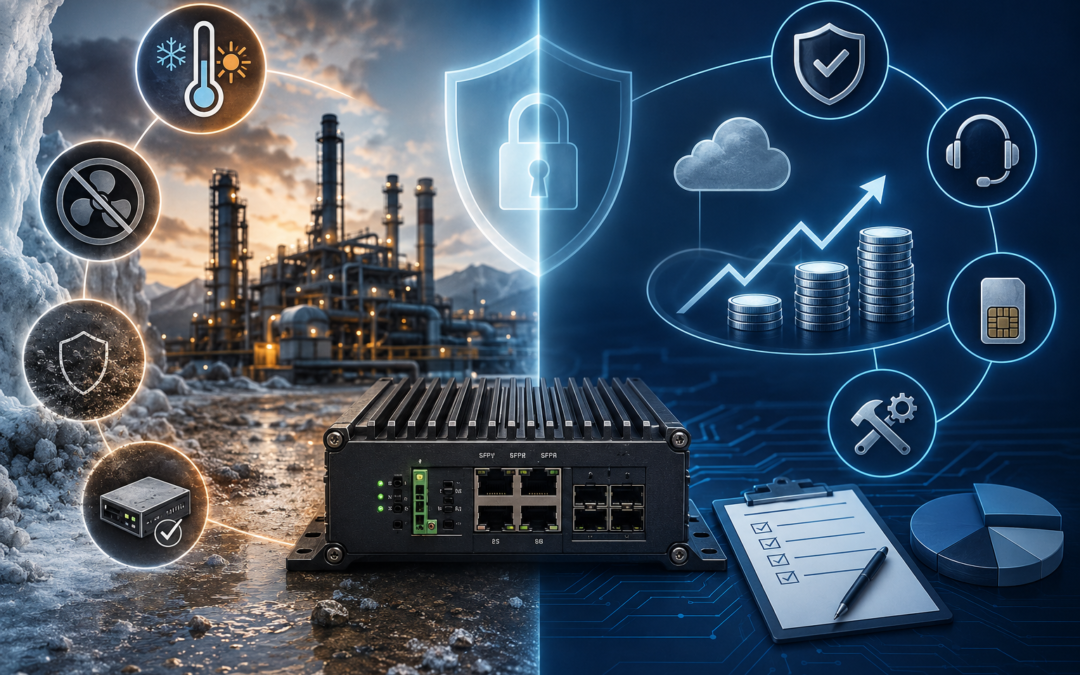
- No moving parts — fanless designs remove a common failure point in dusty, hot, or vibrating environments. A failure on a remote site is not just a part cost; it is a truck roll, downtime, and possibly lost production.
- Lower cooling load — Many rugged firewalls in this class draw modest power, often in the 15–25W range, though larger models and PoE/edge-compute platforms can be higher and publish their heat output in BTU/h. Low, predictable heat means less cabinet cooling, which matters at scale across many cabinets.
- Wide temperature tolerance — a −40°C to +75°C range. Wide temperature tolerance can reduce or avoid the need for active climate-controlled enclosures in some sites, but cabinet-level thermal design is still required.
- Single SKU across sites — wide DC input ranges and flexible mounting let one model serve many site types, reducing the number of distinct spares you stock and the training burden on field staff.
None of these show up in a price comparison against a cheaper commercial box, which is precisely why the cheaper box can cost more over five years.
The recurring cost most buyers underestimate
The hardware is bought once; the protection is rented continuously. Next-generation firewall value comes from threat-intelligence services — intrusion prevention, anti-malware, web and DNS filtering, application control, OT security, sandboxing — and these are subscription services, sold in bundles at different tiers. A device with no active subscription is a stateful firewall, not a next-generation one.
Vendors typically package these as tiered bundles — for example an entry bundle with core IPS and anti-malware, a mid bundle adding filtering and inline prevention, and a top bundle adding OT-specific security and broader services. On top of the security bundle sits a separate support/warranty tier (hardware replacement, firmware, technical support), which is also recurring. When you model TCO, count both, for every device, for the full intended service life — typically the largest single component of the lifetime cost.
| Cost component | Frequency | Easy to miss? |
| Hardware appliance | One-time | No |
| Enclosure / mounting / antenna | One-time | Sometimes |
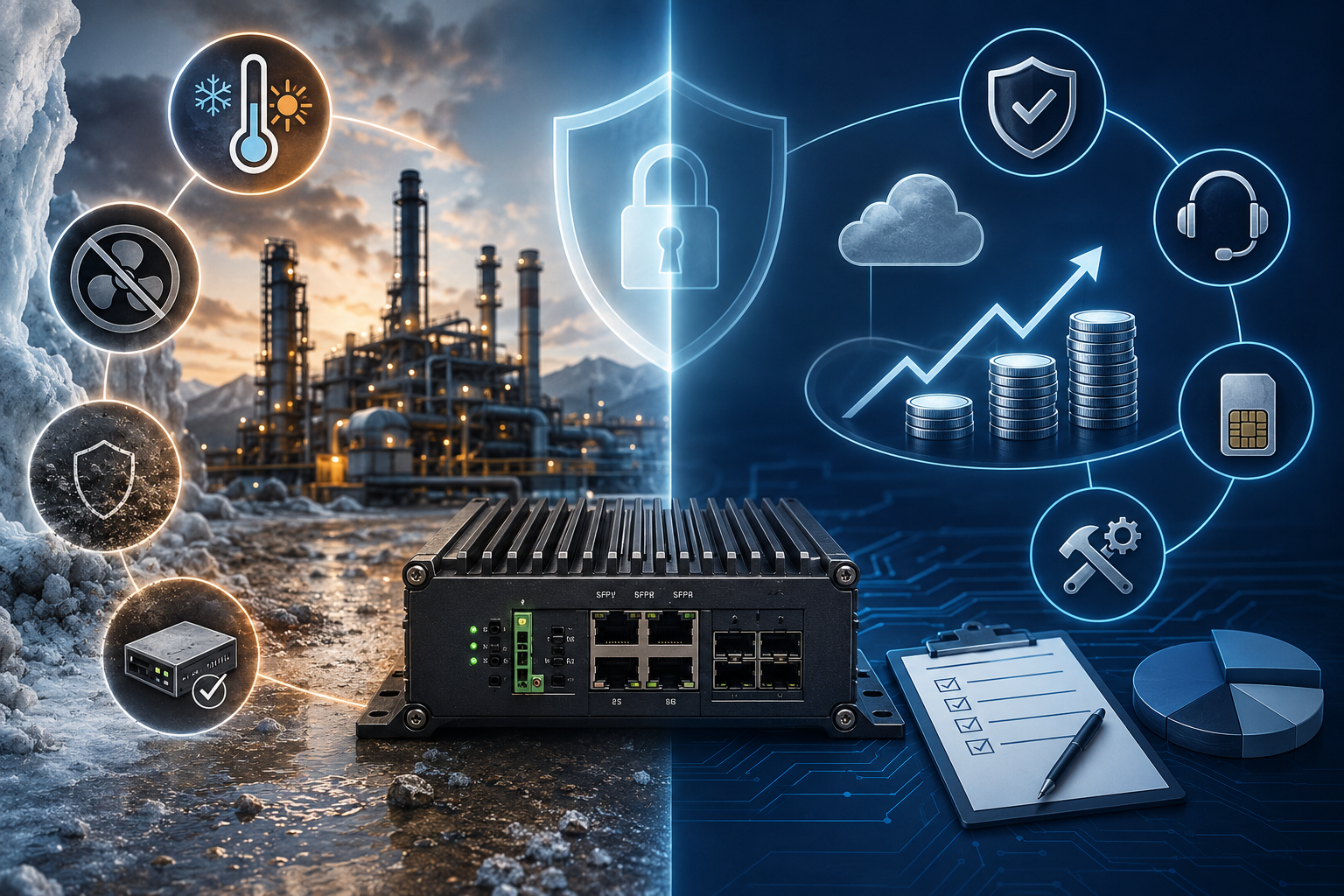
| Security service bundle | Recurring (annual) | Yes — often the biggest |
| Support / warranty tier | Recurring (annual) | Yes |
| Cellular data plan (per site) | Recurring | Yes |
| Install, config, lifecycle mgmt | One-time + ongoing | Sometimes |
Firmware policy is a cost and a risk
Two firmware realities catch buyers out. First, some features are tied to specific operating-system versions or hardware capabilities — in the worked example, a client VPN feature is dropped from a certain firmware version onward on some models, with a recommendation to stay on a long-term-support branch to retain it. If you build a design around a feature, confirm it survives the firmware you intend to run. Second, security subscriptions require staying on supported firmware to keep receiving updates, so “we’ll never touch it again” is not a viable plan for a security device — lifecycle management is an ongoing operational cost, not a one-time install.
| For the budget meeting Model five years, not one. Take the hardware price, add enclosure and install, then add five years of the security bundle, five years of support, and five years of any cellular data plans. The recurring lines usually dwarf the appliance price — and that five-year number is the honest basis for comparing a rugged NGFW against any alternative. |
A fair comparison framework
When you compare a rugged next-generation firewall against a cheaper commercial device or a do-nothing baseline, put everything on the same five-year footing:
- Capital: appliance, enclosure, mounting, antennas, transceivers.
- Recurring: security bundle, support tier, cellular plans — times five years.
- Operational: install, configuration, ongoing management and firmware maintenance.
- Avoided cost: the failures, truck rolls, cooling, and downtime the rugged design prevents — estimated honestly, since these are the rugged premium’s justification.
- Risk-weighted: the cost of an OT security incident the device is there to prevent, even at a modest probability.
The point of the framework is not to make rugged hardware always win — sometimes a commercial box in a clean control room is the right call. The point is to make the decision on the full number, so the cheap option that is actually expensive, and the premium option that actually pays for itself, are both visible before the purchase order is cut.
Vays Infotech helps enterprises evaluate, deploy, and support firewall, network, and cybersecurity infrastructure across IT and industrial environments.
