

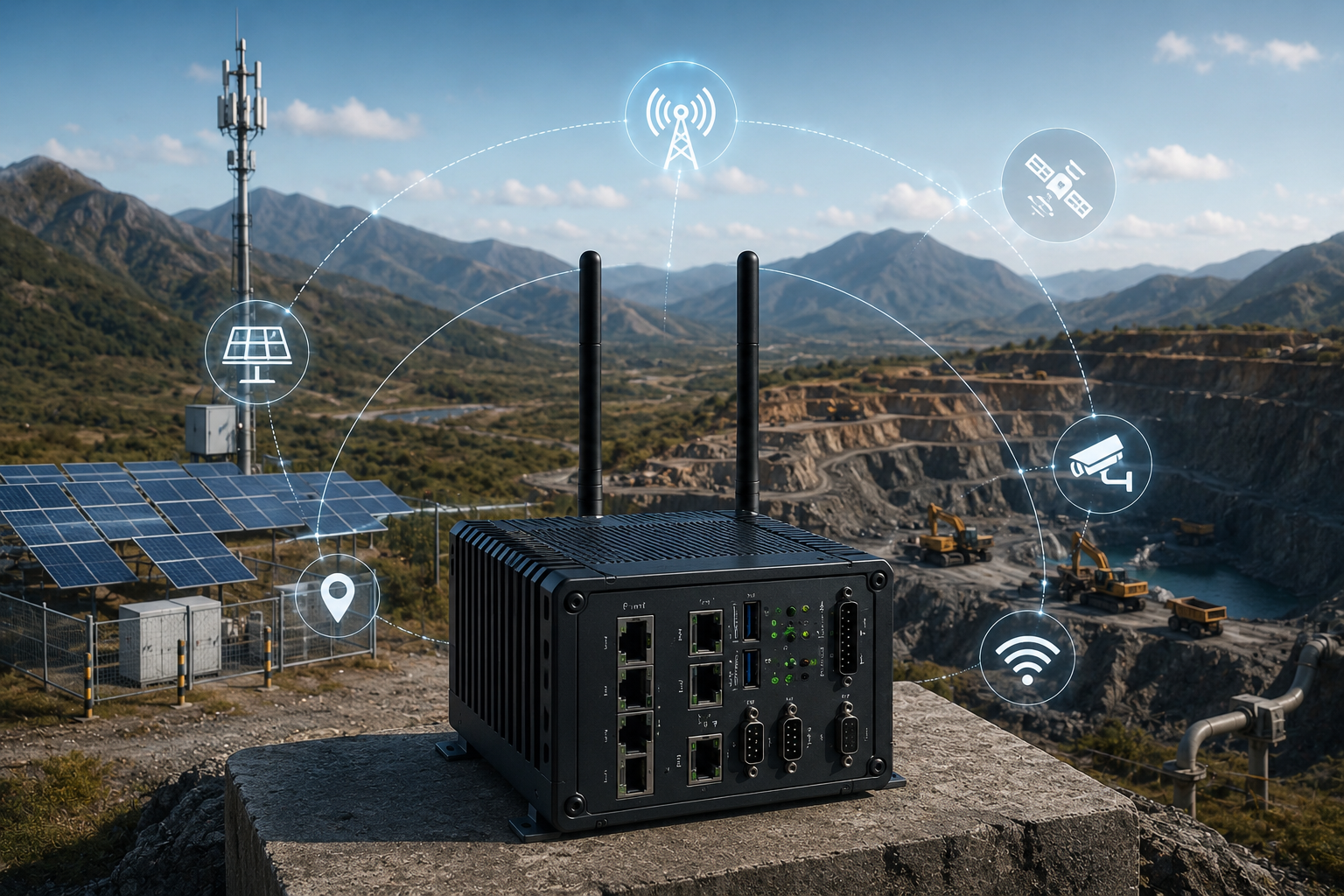
An unmanned solar farm, a remote pumping station, or a mine perimeter has a problem an office never has: there may be no wired internet, and there is no one on site to reboot a router when the link drops. For these sites the WAN is cellular, and the quality of the cellular subsystem in the edge firewall determines whether the site stays reachable or goes dark for a day until someone drives out. This article unpacks the cellular and GPS capabilities now built into rugged firewalls and why the details — dual SIM, dual modem, band coverage, public-safety support — decide reliability at the edge.
Why cellular is the primary WAN, not the backup
In enterprise networking, cellular is the failover that sits behind fibre. At a remote industrial site the relationship inverts: cellular is often the only WAN, and the design question is how to make a single radio path as reliable as a wired one. The answer is redundancy inside the cellular subsystem itself — multiple SIMs, and on the higher tiers multiple modems — combined with SD-WAN logic in the firewall that steers and heals around a degraded path.
Dual SIM: active/passive versus active/active
Two SIM slots is now common, but how the device uses them varies and the difference is operationally significant.
- Active/passive — one SIM carries traffic; the second is a standby that activates when the first loses service. This protects against a single carrier outage. Failover takes a few seconds while the second SIM registers.
- Active/active — both SIMs are registered and usable at once, enabling faster failover and, with dual modems, simultaneous use of both paths. This is what an always-on remote site wants.
In the worked example, the LTE variant uses active/passive dual SIM, while the top dual-5G model uses active/active across two modems. The cost step between them buys genuinely different resilience, so tie the choice to the consequence of an outage rather than to budget alone.
One modem or two
A single modem with dual SIM protects against a carrier problem but not against a modem problem, and it cannot use two networks at the same time. Two modems give a true second radio path: the device can run both carriers concurrently, fail over almost instantly, and load-share. For a site where a lost day of connectivity means lost generation data or a missed safety alert, the dual-modem model earns its premium.
Bands, regions, and the questions to ask your carrier
Cellular only works if the device supports the bands your carrier uses at that specific location. Modern 5G modules cover an extensive list of 5G NR, LTE, and legacy bands, but coverage is meaningful only against the carrier and the site. Before specifying:
- Identify the carrier(s) with usable coverage at the exact site coordinates — not the nearest town.
- Confirm the bands those carriers use there are on the module’s supported list.
- Check the module’s carrier certifications — some carriers require an approved device for onboarding onto their network.
- For mission-critical or public-safety use, check support for priority networks (for example dedicated public-safety services).
The worked example illustrates the range: its 5G module supports a broad sweep of NR bands and carries a long list of regional and carrier certifications, including public-safety network capability on the dual-5G model. That last point matters for utilities and critical infrastructure that may be entitled to priority connectivity during congestion or emergencies.
GPS: more than a dot on a map
The cellular variants include GPS, and it does two useful jobs at an industrial edge. First, asset location — valuable for distributed solar strings, mobile equipment, and any estate where you need to know which box is where without a site visit. Second, a time reference; accurate time underpins log correlation, certificate validity, and any protocol that is time-sensitive. For distributed energy and mobile assets, the built-in GPS removes the need for a separate timing or tracking device.
Putting it together: a resilient remote edge
A robust unmanned-site design layers these capabilities. The firewall terminates one or two cellular paths; SD-WAN policy treats them as overlay links and steers traffic by health and policy; if the primary path degrades, traffic shifts to the secondary before an operator would ever notice. The same device runs the security stack locally, so the site is protected even while disconnected, and GPS provides location and time. The result is a site that behaves like it has a wired, monitored connection — without anyone on site and without a truck roll for every hiccup.
| Field tip Cellular coverage is hyper-local. A site 500 metres from a road with strong signal can sit in a dead spot behind a hill or inside a steel structure. Validate signal at the actual mounting point with the actual antenna before committing the design, and plan antenna placement (and cable runs) as part of the install, not an afterthought. |
Vays Infotech helps enterprises evaluate, deploy, and support firewall, network, and cybersecurity infrastructure across IT and industrial environments.
