

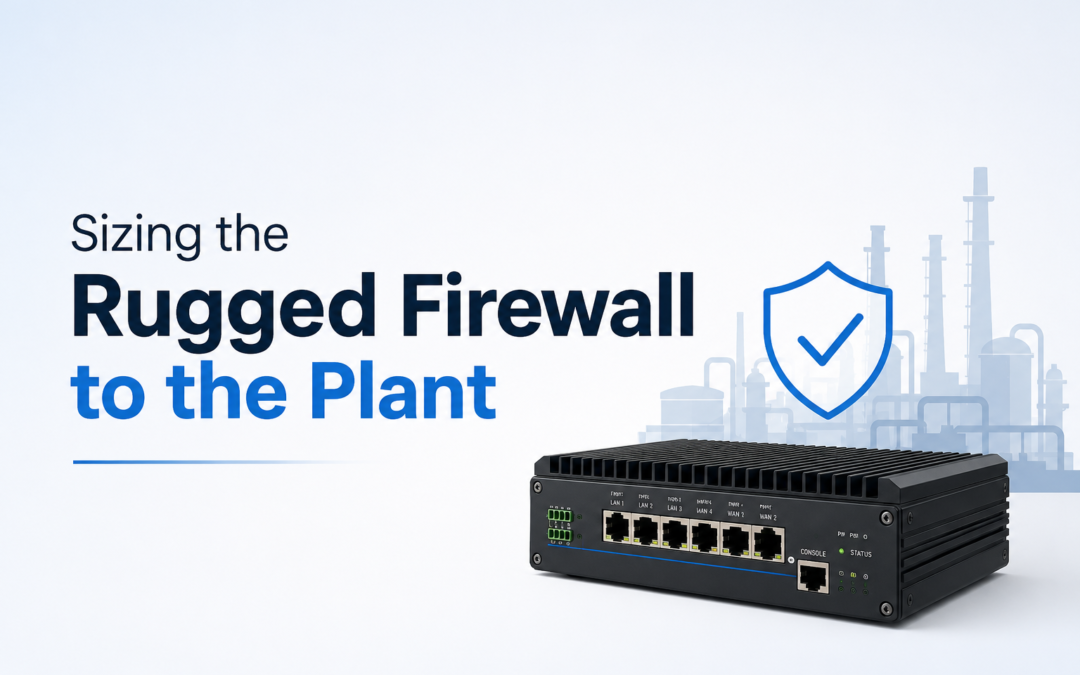
A rugged firewall series usually spans a dozen variants that look almost identical on a shelf and behave very differently in the field. The catalogue lists them by performance tier, but performance is rarely what decides the right model for an industrial site. Connector type, power input range, cellular options, fail-to-wire behaviour, and certification usually matter more than another half-gigabit of throughput. This guide reframes the selection question around the environment rather than the spec ladder, using a representative rugged series as the worked example.
Start with the environment, not the throughput
For most industrial sites the binding constraints are physical and electrical long before they are about packet rate. Work through these four questions first:
- How will it physically connect? Standard RJ45, or vibration-proof M12 connectors?
- What power is available? A 24V panel, a 48V telecom plant, or a 110V DC substation battery?
- Does it need its own WAN? Is there fibre, or does the site depend on cellular — and does it need carrier redundancy?
- What must happen if the box fails? Can the link drop, or must traffic keep flowing on a critical control loop?
Only after those are answered does throughput become a tie-breaker between the remaining candidates.
Connectors: when RJ45 is the wrong choice
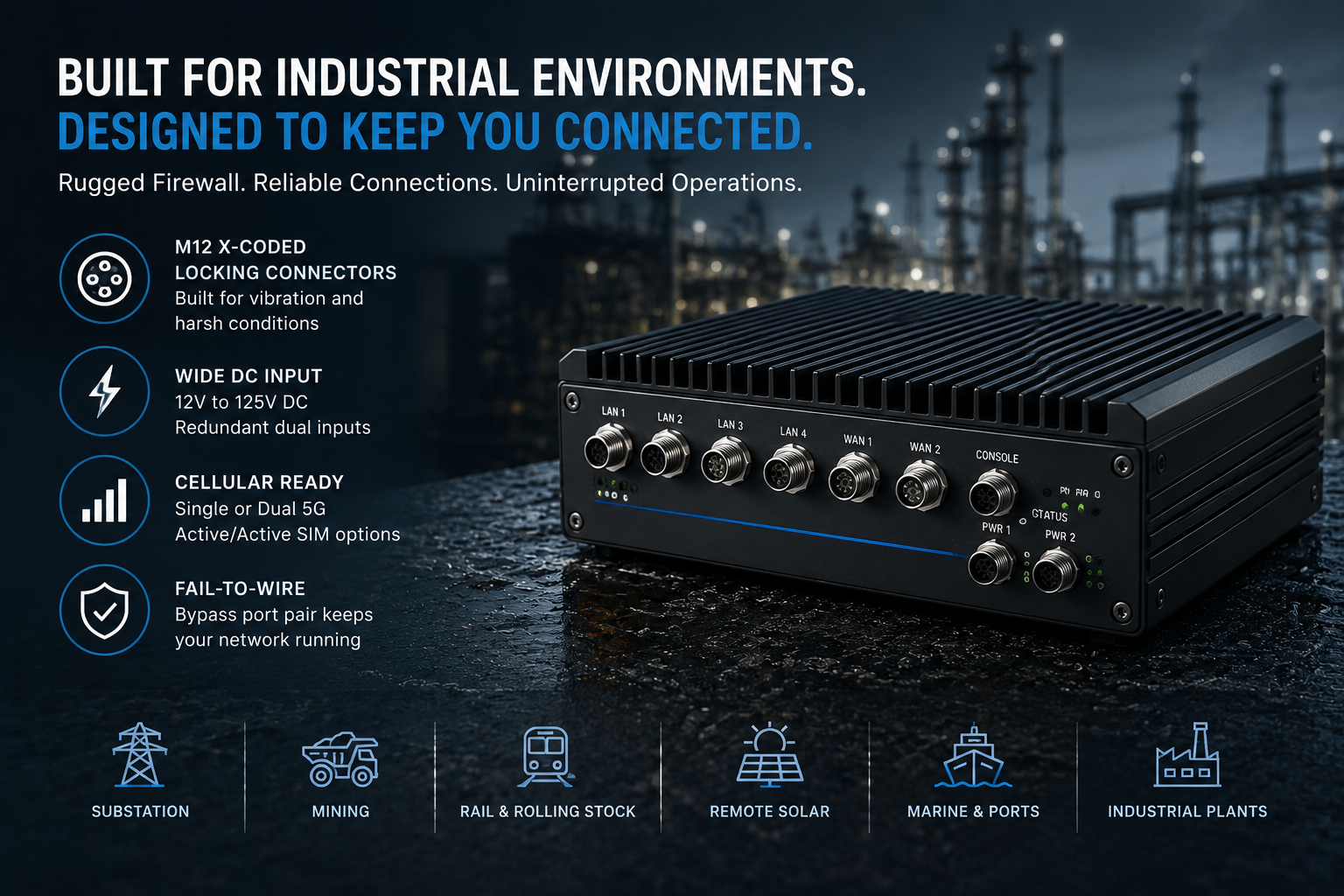
On a desk, RJ45 is fine. On a locomotive, a mining shovel, or a vibrating press line, an RJ45 latch works loose and the link drops intermittently — the worst kind of fault to diagnose. This is why rugged series often include an M12 X-coded variant, where the connector threads and locks. In the worked example, one model is offered with M12 X-coded LAN, WAN, serial, and console ports and even M12 K-coded power connectors. For high-vibration rolling-stock and heavy-mining deployments, the M12 variant is not a luxury; it is what keeps the link up.
Power input: one SKU, many plants
The wide DC input range on rugged firewalls is what lets the same device serve very different sites. A range such as 12V to 125V DC with redundant dual inputs covers 24V control panels, 48V telecom racks, and 110V DC substation battery systems from a single part number, with negative or positive ground. Redundant dual inputs let you feed the device from two independent sources so a single supply failure does not drop the firewall. When standardising across a mixed estate, the breadth of this input range can be the deciding factor — it reduces the number of distinct SKUs and spares you have to stock.
Cellular and GPS: for sites where fibre never arrives
Remote solar farms, pump stations, and mine perimeters frequently have no wired WAN at all. Here the cellular variant is the product. The meaningful distinctions are:
- Single vs dual modem — a single LTE or 5G modem gives connectivity; dual 5G modems give true path redundancy across two carriers.
- SIM behaviour — active/passive failover (one SIM at a time) versus active/active (both live), the latter enabling load sharing and faster failover.
- GPS — included on the cellular variants for asset location and time reference, useful for distributed solar and mobile assets.
In the worked example the range runs from a single-5G model, through a single 3G/4G LTE variant, up to a dual-5G model with active/active SIMs and public-safety-network capability. Match the tier to how punishing the loss of connectivity is: a billing meter can tolerate active/passive; a remotely operated site that must never go dark wants dual modems.
Fail-to-wire: the bypass port pair
Many rugged models include a bypass port pair: a designated pair of ports that, on power loss or device failure, physically short together so traffic keeps flowing. On a protection-critical control loop, this is the difference between “the firewall died and the line kept running” and “the firewall died and the line stopped.” If you place a firewall in-line on a circuit that must not be interrupted, confirm the model has a bypass pair and that the pair is on the ports you intend to use — the datasheet specifies exactly which port numbers form the pair, and it differs between models.
A site-to-model selection guide
| Site / environment | Decisive attributes | Typical fit | ||
| Electrical substation | IEC 61850-3 / IEEE 1613, wide DC input, redundant power | IP40 standard model, certified variant | ||
| Mine / heavy vibration | M12 locking connectors, shock & vibration certs | M12 X-coded variant | ||
| Rolling stock / rail | EN 50155, EN 50121 family, vibration tolerance | Rail-certified rugged model | ||
| Remote solar / unmanned | Dual 5G, active/active SIM, GPS | Dual-cellular variant | ||
| Branch plant with fibre | Bypass pair, SFP uplinks, throughput headroom | Standard rugged model | ||
| Port / marine | IEC 60945 / DNV approval | Maritime-approved variant | ||
| Engineering note Certification and connector type are usually model-specific, not series-wide. Two variants in the same family can differ in M12 availability, cellular bands, and which industry certifications are completed. Always validate against the exact SKU you intend to order, and treat “in progress” certifications as not-yet-available for compliance purposes. | ||||
The throughput tier still matters — it sets how much inspected traffic the device can carry and how many tunnels and sessions it supports — but in industrial selection it is the last filter, not the first. Get the environment, power, connectivity, and failure behaviour right, and the performance tier usually narrows to one or two obvious choices on its own.
Vays Infotech helps enterprises evaluate, deploy, and support firewall, network, and cybersecurity infrastructure across IT and industrial environments.
